


Tea as a Symbol of Peace: The III International Festival “Tea, Culture, Peace!” held in Samarkand

On May 19, 2025, Samarkand once again became a venue for intercultural dialogue, shared values, and cross-generational exchange. The III International Festival “Tea, Culture, Peace!” took place at the “Eternal City” complex of the Silk Road Samarkand tourist center. The event, organized by the Samarkand International University of Technology, was timed to coincide with the United Nations’ International Tea Day.
The festival aligned with several global initiatives, including China’s “Belt and Road” initiative and “2025 – The Year of Environmental Protection and Green Economy” in Uzbekistan. It was also held in anticipation of the 43rd Session of the UNESCO General Conference, scheduled for October–November 2025 in Samarkand.


The festival was supported by Amir Tea Samarqand, ERIELL, Enter Engineering, SANEG, and several leading Chinese academic and cultural organizations, including the International Project “Teo, Amo kaj la Mondo”, Tianjin University of Science and Technology (TUST), Zhejiang A&F University (ZAFU), the International Tea Culture Foundation (ITCB), Foreign Languages Press (Beijing), and Esperanto associations TEA (Tianjin) and PEA (Beijing). Chinese companies such as Yinlu (Hangzhou), Jin Huang Porcelain (Liling), Shenzhen Biwu Tea Culture Communication Co., Ltd, and Jingzhaotang (Wuyishan) also contributed, along with the Embassy of the People’s Republic of China in Uzbekistan, Northeast Electric Power University (Jilin), and the Confucius Institute in Samarkand.
To support the festival, Chinese partners sent a selection of premium teas, new books in English, Russian, Chinese, and Esperanto, and other cultural materials to Samarkand.


The festival featured the international photo exhibition “Teo, Amo kaj la Mondo” (“Tea, Love and World”), along with a curated display of Chinese traditional paintings on the theme of tea, jointly presented by SIUT and Chinese partners.
Tea is one of the world’s most significant crops — a plant with over 5,000 years of history. Its contributions to health, culture, and socioeconomic development remain highly relevant today. Originating in China, tea culture has become globally recognized. In 2022, UNESCO added the traditional Chinese tea processing and brewing techniques to the Representative List of the Intangible Cultural Heritage of Humanity. In Central Asia, including Uzbekistan, tea is more than just a beverage: it is a lifestyle and an integral part of daily family life, with unique centuries-old traditions.
Recognizing tea’s long history and its cultural and economic significance, the United Nations General Assembly declared May 21 as International Tea Day (resolution A/RES/74/241) on December 19, 2019. Member states were encouraged to observe the date by promoting awareness of tea’s importance through education and public engagement. In 2025, the day is being celebrated under the theme “Tea for Better Lives”.
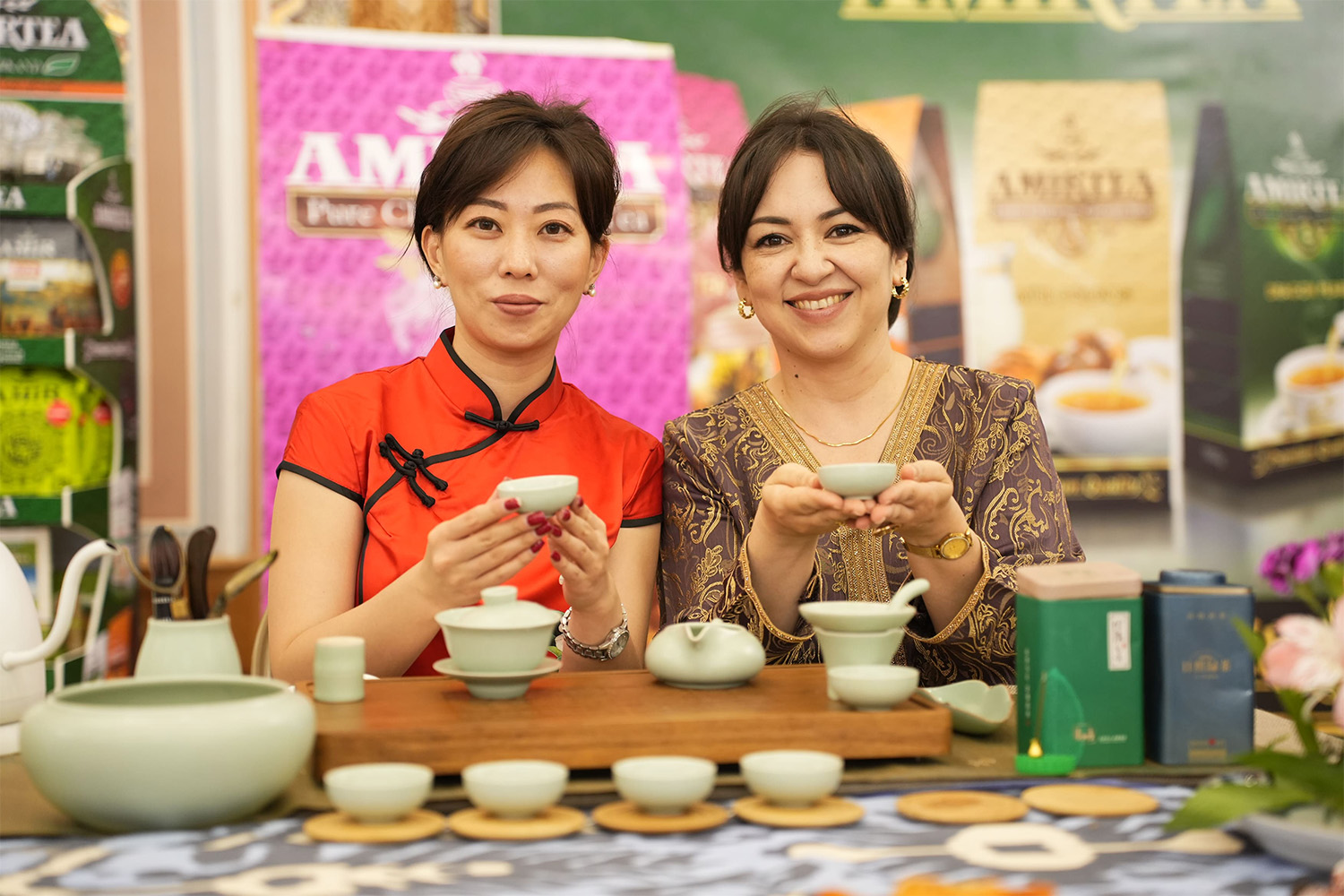
The festival aims to promote the traditions of tea culture in Uzbekistan, particularly among younger generations; to present the richness of Uzbek tea traditions at both local and global levels; to highlight the culture of hospitality that accompanies tea rituals worldwide; and to introduce visitors to the tea customs, brewing techniques, and ceremonies of different nations.

In his welcome address, Nazir Alievich Ibragimov, Advisor to the Hokim of the Samarkand Region, emphasized the importance of hosting such international events in Samarkand — a city that for centuries has served as a crossroads of cultures, traditions, and caravan routes, where tea has always held a special place.


Warm video greetings were sent by H.E. Yu Jun – Ambassador Extraordinary and Plenipotentiary of the People’s Republic of China to the Republic of Uzbekistan; Prof. Wang Xufeng – renowned tea expert and author of the acclaimed “Tea Masters Trilogy”; Mr. Hu Kaimin – President of Foreign Languages Press (FLP), Vice-President of the China Esperanto League (ĈEL); Prof. Wu Zhenjun – Director of International Exchanges, Tianjin University of Science and Technology (TUST); Dr. Zhang Shuai – Head of the International Tea Culture Foundation (ITCB), Deputy Director of the Tea Culture Institute at ZAFU; Mr. Han Zuwu – Honorary President of the Tianjin Esperanto Association (TEA); Representatives of the Beijing Esperanto Association (PEA) and Zizhuyuan Nature Park Exhibition Complex.
Each message emphasized the festival’s core idea: tea brings unity, peace, and inspiration.
SIUT also received video greetings from participants of the “Teo, Amo kaj la Mondo” project, sharing the phrase “Did you drink tea today?” in 50 languages and dialects.


The festival featured interactive activities such as the “Unravel the Secrets of Tea” quiz, musical and dance performances, and tea ceremonies by SIUT professors from different countries, who shared their national tea traditions and what each cup of tea means to them.
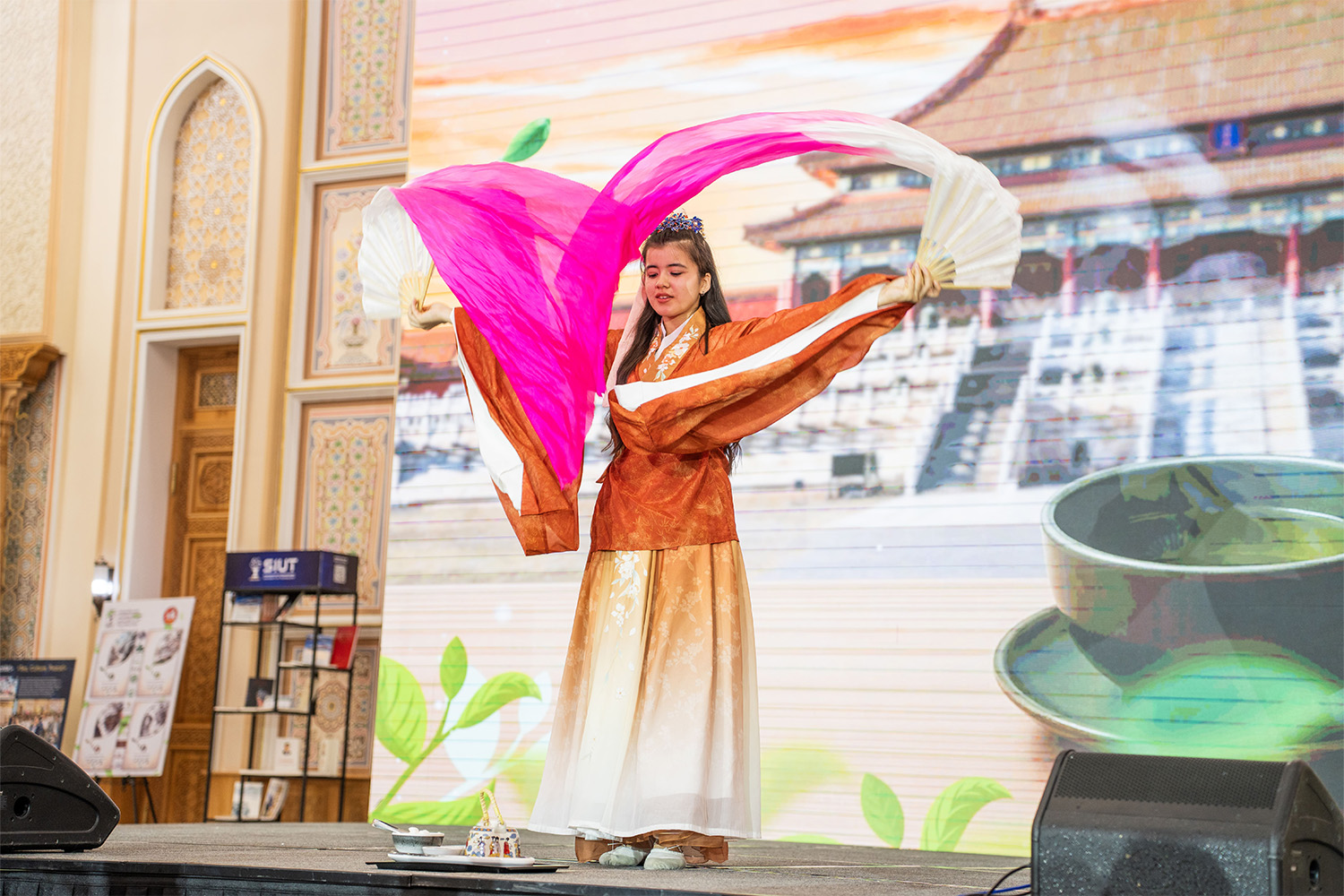
A highlight of the program was a theatrical performance by SIUT’s student theater studio “Oltin Meros”, which re-enacted tea ceremonies from China, India, Japan, Korea, Russia, and Uzbekistan. Through colorful costumes, vibrant dances, and music, the performance conveyed the spirit of hospitality, cultural respect, and unity that tea represents.

A special recognition was awarded to SIUT students for their volunteer work across all three years of the festival. The honorary diploma, designed in traditional Chinese calligraphy and painting, expressed gratitude for their dedication:
“Dear students of Samarkand International University of Technology, we sincerely thank you for your volunteer service and remarkable contributions to the organization and success of the ‘Tea, Culture, Peace!’ Festivals (2023–2025) in Samarkand. We hope that through tea culture exchanges, you will better understand China, deepen the traditional friendship between China and Uzbekistan, and contribute to peace, environmental protection, and sustainable development worldwide”.

The diploma, in Chinese and Esperanto, was signed and sealed by administrations of TUST, ITCB, ZAFU, TEA, FLP, and PEA.
Meanwhile, in Beijing’s scenic Zizhuyuan Park, the ongoing “Teo, Amo kaj la Mondo” exhibition showcases over 300 artifacts from around 60 universities, museums, cultural institutions, and tea companies. Uzbekistan is represented by SIUT and “Amir Tea Samarqand” company. The Uzbek section features displays on the Samarkand tea festival, a Chinese-language edition of “The Biography of Samarkand” (from the “Cities of the Silk Road” series), Esperanto translations of the poem “Bir piyola choy” by renowned poet and SIUT professor Khosiyat Bobomurodova, and lyrics from the beloved song “Музыкальная чайхана” (“Musical Teahouse”) by the Yalla vocal and instrumental ensemble. Visitors can also sample top-quality Uzbek teas prepared by Amir Tea.
On the eve of the festival, Foreign Languages Press (FLP) donated more than 40 new titles to the SIUT library, adding valuable resources to the university’s multilingual collection.
As a commemorative gift, each guest received a special edition tea package branded with the logos of SIUT and Amir Tea Samarqand.


Though the festival has concluded, its atmosphere will linger — in the aroma of tea, the shared smiles, and the moments of connection. If one cup of tea can bring people closer, then thousands of such encounters can change the world.
See you again at the next International “Tea Culture. Peace!” Festival!


